What a single gateway account looks like
A business that runs on one payment gateway account connects to one provider's gateway and works inside that provider's dashboard. Routing, the list of available payment methods and the reporting a merchant sees all come from that one connection, because there is nothing else to route to or report from.
Routing across more than one provider
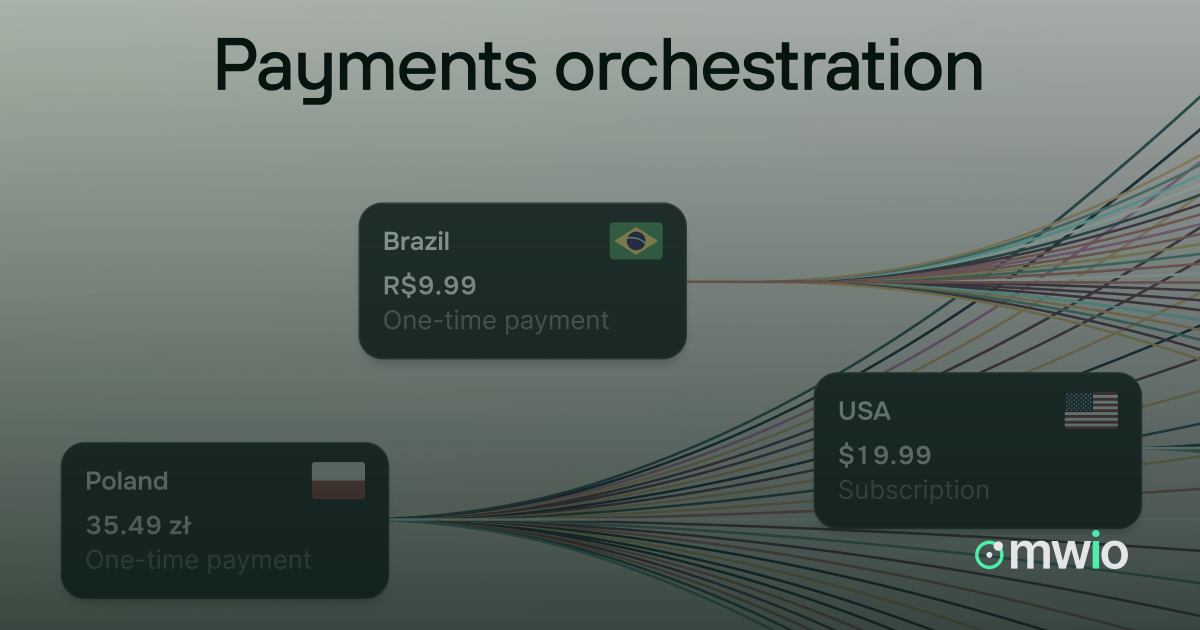
omwio treats providers as modules that a tenant attaches, with MIDs registered against each one. Every currency gets its own enabled set of payment methods, and a manager can preview how a route resolves for a given merchant and method before any real traffic reaches it. With a single gateway account, routing and the method list are whatever that one provider offers; on omwio, routing is a decision the platform makes across however many providers and MIDs are attached.
One model for every kind of transaction
Payments, payouts, exchanges, refunds and chargebacks are all transactions in omwio, sharing one status model and one collapsed status mapping that merchants see regardless of which provider actually processed the money. Multi-currency wallets per merchant carry balance history and reserve visibility, and conversion and provider analytics can be ranked by merchant, provider and MID, and filtered by currency, status and period. A single gateway account's reporting is bounded by what that one provider's dashboard shows; it has no reason to break volume down by provider or MID, because there is only one of each.
Checkout, invoices and disputes in the same place
omwio's hosted checkout runs on the tenant's own pay host, and provider-specific quirks are normalised into canonical payment instructions before they reach anyone integrating through the Processing API. Merchants can also raise invoices and send them through branded mail for payers to settle on a public page. The post-payment path — refunds, chargeback handling and a structured dispute workflow — is part of the same baseline: a manager can let a merchant open disputes on its own payments and payouts, with a reason and up to five evidence files, and the manager resolves them with balances rolled back and re-posted automatically.
Watching provider health and reconciling what settles
Two optional modules extend this further. Monitoring tracks success rates, latency and error mix per provider and per MID — not just as one global number — and alerts point at the specific route that is failing. Accounting & reconciliation keeps treasury per currency, a daily P&L that closes and is corrected only by a dated reversal, and an import-and-match process that checks provider statements against platform transactions on amounts, references and timing windows. Both are enabled per billing plan rather than built into every tenant by default. Neither question — which route is degrading, and whether a statement actually matches the books — has an equivalent on a single gateway account, since both only make sense once there is more than one provider or MID to compare.